Blog · November 25, 2026
Alex Hormozi's YouTube Advice for B2B Founders: 8 Lessons
Alex Hormozi's YouTube advice, filtered for B2B founders who sell one high-ticket service: 8 lessons, how we use each one, and the one to skip.
The short answer: Alex Hormozi’s YouTube advice comes down to a few rules: make content for buyers, not viewers, go narrow, use long videos to sell, lead with proof and tell the truth, say exactly what each video is, and give away your best ideas. Seven of his eight big lessons work for a B2B founder with a small channel. One, his decade-long patience, doesn’t. You need YouTube to pay for itself this year.
Want this done for your channel? Book a 20-minute call with Zed.
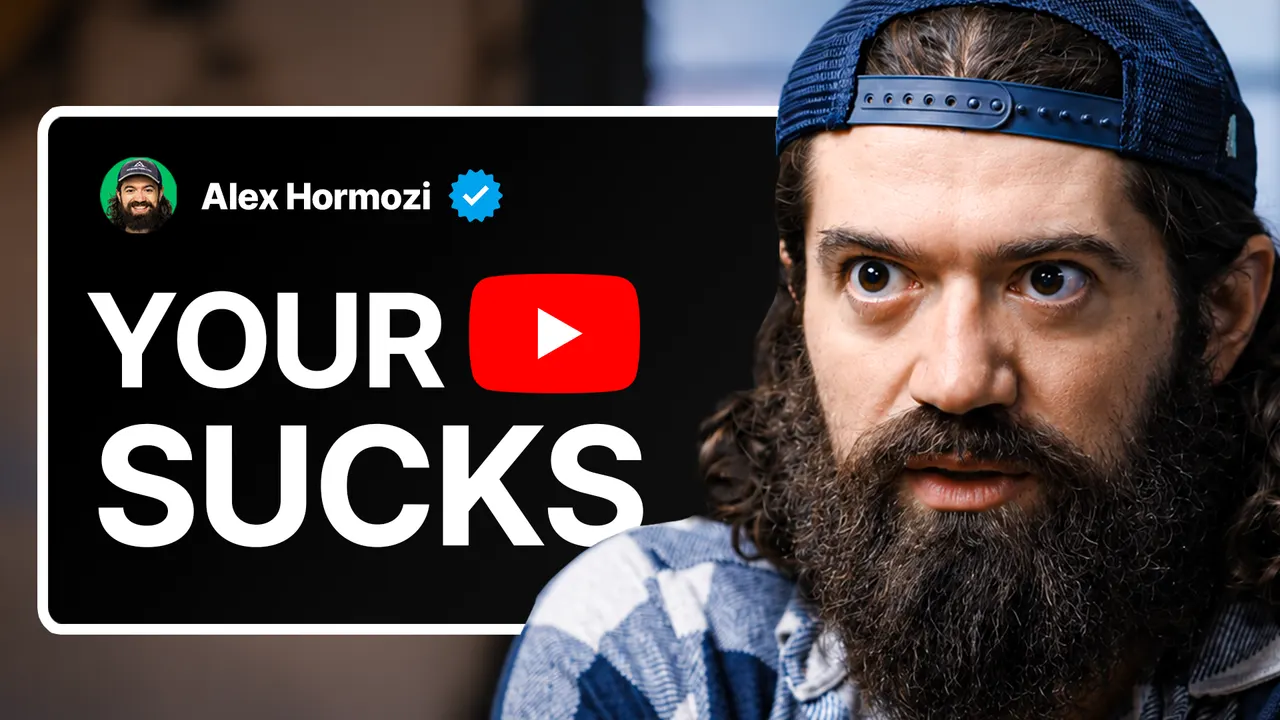
The video above covers all 8 lessons with Hormozi’s own clips.
Key takeaways
- Views from the wrong people can cost you money. Hormozi saw more views and less revenue when he chased entertainment.
- A narrow channel collects clients. A broad one collects views. You can’t build both at once.
- Long videos do the selling. Put one in every booking confirmation email.
- Open with proof that fits the video, then show it on screen instead of claiming it.
- Copy his standards, not his volume or his timeline. A few videos a month for people who can pay you is enough.
Why Alex Hormozi’s YouTube advice is worth studying
Hormozi has spent real money working out what makes content pay. In one of his videos he puts it at “$4 million in team, equipment, vendors, studios, and software,” a thousand hours on camera and 35,000 pieces of content.
Most of what he learned is spread across hours of video. I went through 10 of his videos and his books and pulled out the parts that matter if you sell one high-ticket service to one type of business. I run a YouTube agency for businesses like that, and we’ve generated over $110,000 for our clients with YouTube so far. So after each lesson, I’ll show how we use it on a small B2B channel and what I’d add.
The quotes below are Hormozi’s own words from his videos, trimmed for length. The “how we use it” parts are mine.
Lesson 1: Not all YouTube views are worth the same
Hormozi’s point is that entertainment viewers want more entertainment, and education viewers want more education. In his words, one group does not become the other “at any appreciable rate that we would build a business around.”
He tested it with his own money. His team ran 90 days of almost no business content, just edutainment and entertainment. Views went up two to three times. “But even with the increase in views, our ad revenue dropped by half,” he says. “So we’re actually getting the wrong people.”
More views, less money, because the extra people were the wrong people.
Put that in your world. Say you run cold email for MSPs. 300 MSP owners watching your video is a full pipeline. 300,000 students watching it is a nice screenshot.
What I’d add: most founders start by asking how to get more viewers. Viewers don’t sign contracts. Buyers do. So before we plan a single video for a client, we answer two questions:
- Who is the one person who would pay for this?
- What problem is that person trying to fix right now?
Every video has to pass both. If it only passes the first, it’s a nice chat with the right person. If it only passes the second, you’ve helped a stranger for free.
Here’s the test we use on a finished channel. Imagine your perfect buyer lands on your channel page. Does every title look like it was made for them? If yes, they watch five videos in a row, and by the fifth you’re the expert. If two titles are for them and eight are for everybody, they leave. That’s why, on a client channel, the first thing we check is who watched. If the comments are full of owners, a video with 400 views is doing its job.
Lesson 2: Go narrow, even if it means fewer viewers
Hormozi had millions of followers and still chose to talk to fewer people. He cut relationships, college, food and lifestyle, and doubled down on business. His question: “how narrowly can I define the problem that I solve so that in that tiny world, in that pond, I am king.”
That’s a specialist founder’s whole advantage. You’ll never be the best marketing channel on YouTube. But Google Ads for law firms might have three people making videos, and two of them are bad.
Founders push back: “Won’t a small niche mean no views?” Two things.
You have to pick. A broad channel is built to collect views. A narrow channel is built to collect clients. Trying to do both gives you neither.
Narrow doesn’t mean you only talk about your service. Your buyer watches other things. A founder who would hire a fractional CFO also watches videos about pricing, hiring and running an agency. So we go through those spaces next door, note what those owners already click on, and bring that topic back to your service.
You stay narrow on who it’s for and get wider on what you can talk about. That’s how a small pond still gives you a year of ideas.
Lesson 3: Long videos sell
“For us, longs drive a lot more conversions than shorts,” Hormozi says, with conversions meaning book sales, opt-ins and applications. Short viewers watch more shorts. Long viewers are the ones who buy.
In one of his books, he shares a number from his own company: 78% of their best customers had gone through at least two long pieces of content before they bought. Then they did something smart with it. They started sending two long pieces to every new lead before the sales call.
Think about what that does. Someone who has watched you for 40 minutes already knows how you think. The call starts at “How do we begin?” and skips “Who are you?”
How we use it: every client gets one long video that teaches their whole method, start to finish. Think of it as a free course. It might never get many views, and that’s fine. Its job is to sit in the booking confirmation email and get watched the night before the call.
Then we add a second one: the story of how the founder got here and why they only work with one kind of business. One video proves you know the work. The other makes them like you. A $3,000-a-month decision needs more than 30 seconds of trust.
If you want the full version of this setup, pattern 16 in how B2B founders get clients from YouTube covers which videos to send every lead before the call.
Lesson 4: Experience first, content second
This one is good news if you’ve run your business for years. Hormozi’s line: “You’ll build a bigger brand making content for six months after a decade of experience, than you will have a decade of content with only six months of experience.”
He tells the story of a gym owner who sold his gyms after nine years and wanted to go online. Hormozi told him to post every day. Six months in, one video took off, then the next, and the content turned into a big business. Nine years of doing the work. Six months of talking about it.
The hard part is done. You have the client stories and the scars. All that’s missing is a camera.
Most founders tell me, “I don’t have time to be a YouTuber.” Good. Don’t be one. A YouTuber has to invent things to say. You only have to say what you did.
The video shape built for this: “I did this many of something. Here’s what I learned.”
- “We audited 40 Google Ads accounts for law firms. Here’s what the best ones do.”
- “I’ve hired 200 engineers for startups. Here’s who gets the offer.”
It works because the number does the bragging for you. But the number has to be real and big enough to matter. Nobody clicks on “I ran three campaigns.”
The inside is simple to film. Each lesson is a short story: what went wrong, what you changed, what happened next. You’ve already told these stories on sales calls, which is why a founder can film a month of them in half a day.
Lesson 5: Lead with proof and tell the truth
Hormozi says most viewers have a sign above their head before they even start listening: “why should I listen to you?” So he leads with proof.
When he was selling to gym owners, he swapped his webinar for a single video titled as a free case study: how they added 213 members and $112,000 to a small gym in San Diego. He says the next morning, the calendar was full. One client, one number, one city. No tricks.
He gave the same advice to a founder: “The truth is the most compelling thing out there from a marketing perspective… The truth sells the most.”
How we open client videos:
| Part | What it does | Example for a cold email agency |
|---|---|---|
| Line 1 | Repeats what the title promised, so the viewer knows they’re in the right place | “Here’s how we book sales calls for MSPs with cold email.” |
| Line 2 | Proof that fits this video, and only this video | A real result for an MSP, not a conference you spoke at |
| The rest | Shows it, doesn’t say it | Open the dashboard, share the screen, point at the number and say when it moved |
| Somewhere inside | Says who it won’t work for | “If you sell to consumers, this isn’t for you.” |
A stranger doesn’t believe a sentence. They believe what they can see.
Saying who it won’t work for feels like it costs you clients. It does the opposite. When you’re honest about where you’re weak, people believe you about where you’re strong. Buyers have heard every big claim already. A true, specific one stands out.
Need ideas to film? I put together 20 YouTube video ideas that are already proven in other niches, ready to point at your buyer. It’s free. Get the 20 video ideas
Lesson 6: Say exactly what the video is
Hormozi admits he had to unlearn the marketing idea that you need curiosity and shouldn’t tell people everything. His view now: if people want the thing, they’ll click on the thing, and then you give them the thing. He calls it “a very hard lesson for me to learn.”
Founders love clever titles. Buyers click clear ones. “How we book sales calls for MSPs with cold email” tells the right person it’s for them and tells everyone else to keep scrolling.
What I’d add: don’t guess the idea either. Before we film anything, we look for videos that did far better than the channel they were posted on. Picture a channel that gets 2,000 views a video, with one sitting at 50,000. That one is telling you what those viewers wanted badly.
We look in your niche and in the niches next to it. Then we borrow the shape that won and lock the title and thumbnail before a word of the script exists. If the right person won’t click, the script never gets heard. The video behind this article is an example: a sales software company used the same title format about cold calling and got over 400,000 views. I pointed that shape at B2B founders.
We do the same with the inside. We map the points first and make sure each one hands off to the next. A list of five tips that have nothing to do with each other gives people five chances to leave. So before a section ends, we tell the viewer why the next one matters.
Lesson 7: Where I’d ignore Hormozi
Hormozi tells a story about signing with a YouTube vendor. On the first call, he said he was in it for a decade and would check in five to ten years whether it was worth it. The vendor told him no client had ever said that. Everyone else wanted leads in the first 90 days.
For him, that was right. He was building a media brand for millions of people, with a team and $4 million behind it.
You have a different job. You need a few hundred buyers to find you, and you need YouTube to pay for itself this year. Those two jobs need different videos. An audience takes years. A case study aimed at one type of buyer can book a call the week it goes up. He proved that himself in lesson 5, when one case study filled a calendar overnight.
So copy his standards and skip his volume. You don’t need 35,000 posts or five platforms. You need a few videos a month, on one platform, made for people who can pay you.
And you can’t wait years to find out if it’s working, so measure it properly. Views and subscribers don’t pay you. We follow each video down a line:
- Did the right people click?
- Did they watch long enough to hear the offer?
- Did they click the link?
- Did they book?
- Did they show up?
- Did they buy?
The weakest step limits everything after it. If owners are watching but nobody clicks the link, more views won’t help. The ask is the problem, so we fix that one step and check again.
To know which video booked which call, put a different link under each video and add one question to your booking form: “Which video brought you here?” Within a month, you’ll know which videos make you money. Then make more of those.
Lesson 8: Give away the secrets, sell the implementation
Hormozi’s warning to anyone scared of giving away too much: if you hold back, people only see “sucky fluff” and decide that’s all you’ve got. “Why would I ever work with him?”
His short version in the book: give away the secrets, sell the implementation. Founders worry that if they explain the whole method, nobody will hire them. The opposite happens. A busy owner watches every step it takes to do it right and thinks, “I’m not doing all that. I’ll pay this person.”
Most people will never buy, but they’ll judge your reputation from your free stuff. So the free stuff has to be your best stuff. And give far more than you ask.
How we handle selling inside a video:
- One short mention near the middle, in the same voice as everything else. About 10 seconds.
- One clear ask at the end, matched to the video. A case study ends with “book a call,” because the viewer just watched proof. A teaching video ends with a free next step, because that viewer needs one more reason to trust you.
- Never teach for 15 minutes and then turn into an advert. People feel that switch, and the trust you built is gone.
FAQ
What is Alex Hormozi’s main advice for YouTube?
Make content for the people who buy, not the people who watch. He saw his views go up two to three times on entertainment content while his ad revenue halved. His other rules follow from that: go narrow, lead with proof, tell the truth, use clear titles and give your best ideas away.
Does Hormozi recommend long-form or short-form content?
For conversions, long-form. He says long videos drive far more book sales, opt-ins and applications than shorts, and his company sends long content to new leads before sales calls. Short videos can reach people, but long ones build the trust a high-ticket sale needs.
Can a small B2B channel follow Hormozi’s advice?
Yes, with one change. Keep his standards (clear titles, proof, honesty, real value) and drop his volume and his ten-year timeline. A few videos a month aimed at one buyer, with each video’s results tracked down to booked calls, is enough for a B2B founder.
How do you know if a B2B YouTube video is working?
Follow it down the line: the right people click, watch long enough to hear the offer, click the link, book, show up and buy. Use a different link under each video and ask “Which video brought you here?” on your booking form. Fix the weakest step first.
Want a 90-day YouTube plan built for your buyer?
I just gave you eight of Hormozi’s lessons and how we use each one. This is a teaching article, so I’ll follow my own rule and end with a free next step.
If your business does $20K or more a month, book a call with Zed and I’ll build you a 90-day YouTube strategy myself: which videos to make first, who they’re for, and how each one leads to a call. It’s free, and it’s yours to keep whether we work together or not. You can see how our YouTube growth agency for B2B founders works first.
Book your free 90-day YouTube strategy call
About the author

Zed is the founder of Maxing Labs, a YouTube growth agency for B2B founders and coaches. He helps B2B founders add $30K to $100K with YouTube, with $110K+ generated and 5M+ long-form views.
Alex Hormozi’s quotes are taken from his public YouTube videos and books. Maxing Labs is not affiliated with Alex Hormozi or Acquisition.com.