Blog · November 25, 2026
How B2B Founders Get Clients From YouTube: 20 Patterns
How B2B founders get clients from YouTube without going full-time: 20 patterns from nearly 1,000 founders, in the order your buyer meets them.
The short answer: B2B founders who get clients from YouTube don’t use a secret trick. After studying close to 1,000 of them, I found 20 patterns they repeat. They write titles their exact buyer recognizes, earn trust by teaching and working on camera, pitch in every video, and send every viewer to one video that sells. None of them became full-time creators to do it.
Want this done for your channel? Book a 20-minute call with Zed.
The video above walks through all 20 patterns in 8 minutes, with real title and channel examples.
Key takeaways
- Write every title for one buyer. Fewer clicks from the right people beat lots of clicks from the wrong ones.
- Teach the first stage of your process in full. Your buyer wants it done for them, so teaching it sells it.
- Pitch in every video, for about 30 seconds, after you’ve given value.
- Point every end screen at one long video that explains your offer. This is how a small channel out-sells a big one.
- Start most videos from ideas that already worked, and reuse title shapes that perform in your space.
Who I studied, and how
For a decade I’ve watched two to three hours of business content a day. Big entrepreneurs, agency owners, consultants, ad buyers and sales experts, all selling high-ticket offers. Over that time I’ve studied close to 1,000 founders who get clients from YouTube.
What they share is a better read on how their buyer’s brain works. That read is why they sign hundreds of clients without turning into full-time creators.
I pulled out the 20 things they do over and over and put them in the order your buyer meets them: the click, the trust, the call, and the system behind it.
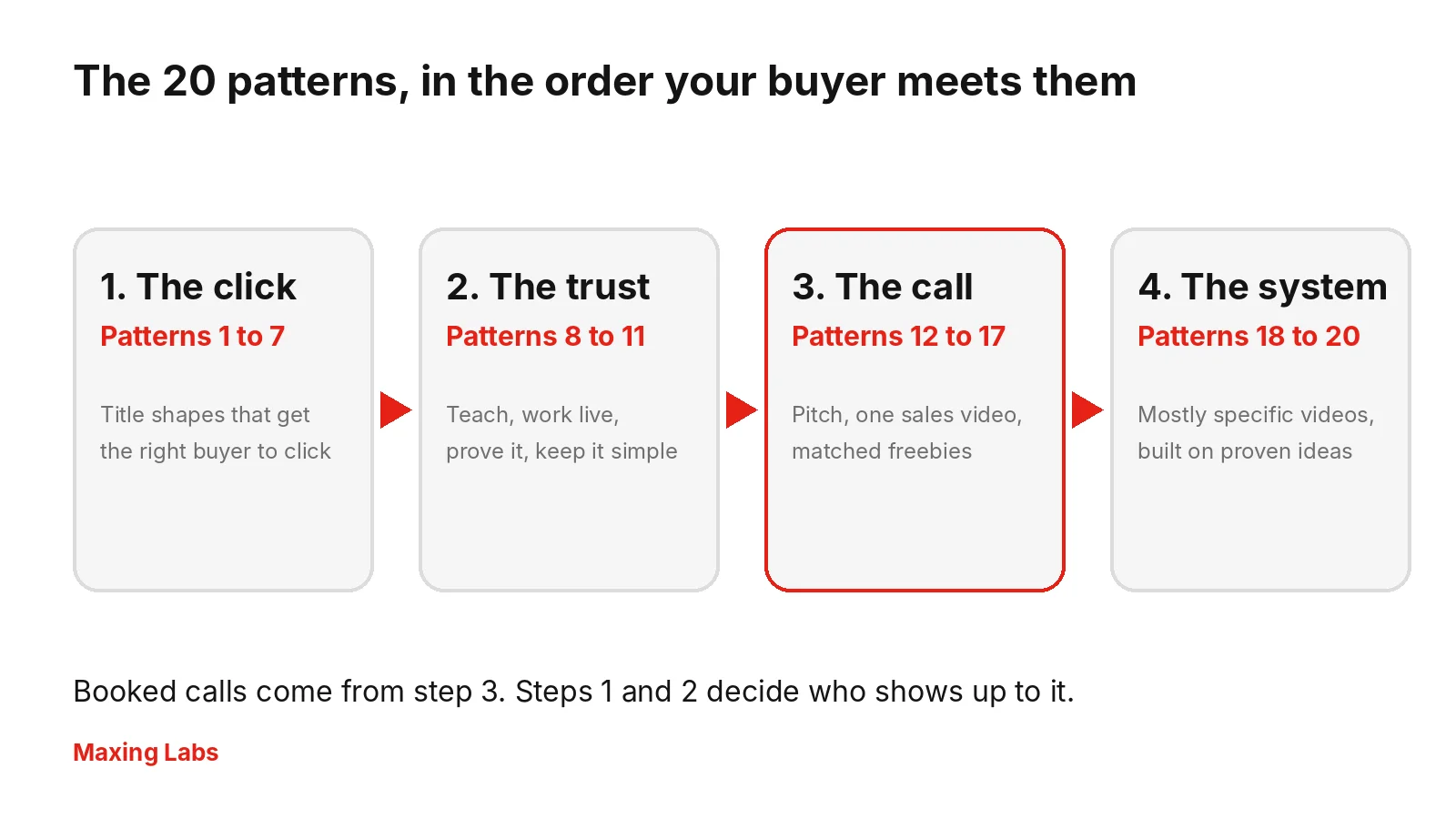
Which YouTube titles get the right B2B buyer to click?
The titles that work for founders are built for one buyer. Your buyer’s brain ignores almost everything but stops for what it already recognizes: a famous name, a price, a real number, a belief it holds, or the exact words of its own pain. These seven title shapes come up again and again.
1. Break down a famous name
The founders who win borrow a name the buyer already knows and break down how that brand or marketer does something. For you, that means breaking down how the biggest name in your buyer’s industry wins.
2. “I paid this person this much”
Value is hard to judge. A price tag makes it easy. “I paid this person this much, here’s what I learned” works because the money proves you were serious and the viewer gets the lesson for free.
Only use it if you really paid. If you haven’t, use time instead: “I spent five years doing this so you don’t have to.”
3. Lead with a real number
Nobody has time to check your track record, so the brain looks for a shortcut. A real number is the fastest one: revenue generated for clients, ad spend managed, deals closed, years in the industry. Put the one your buyer cares about most in the title or the first sentence. Real numbers only. Your buyer is skeptical, and proof is what gets past that.
4. Say the common advice is wrong
The brain pays attention when someone says a thing it believes might be wrong. That’s why “don’t do this, do that instead” keeps winning. Find the common advice in your buyer’s industry that’s quietly costing them money, say it plainly in the title, then prove it in the video. If you can’t back it up, don’t say it.
5. Name the change in the market
When a market changes, people feel it before they can explain it. The founder who names it looks like the one who saw it first. Spot a change your buyers keep complaining about and give it a two- or three-word name. Then explain what changed, who’s losing, and what the winners do now. It’s a shortcut to being seen as the authority in your market.
6. Call out the buyer’s revenue
A broad title gets more clicks from the wrong people. The founders who get clients put the buyer’s revenue level in the title. Fewer people click, but the right ones do. It’s the qualifying question from your sales call, asked in the title. Use the revenue level where your best clients sit.
7. Use the buyer’s exact words for their pain
A vague problem gets ignored. An exact pain gets clicked, because the brain instantly says “that’s me.” Go through your sales call notes and write down the sentences prospects used to describe their problem. Use their wording, word for word. Those sentences are your titles.
| # | Title shape | Why the buyer’s brain stops | Use it when |
|---|---|---|---|
| 1 | Famous-name breakdown | It recognizes the name | A big player in your buyer’s industry does something well |
| 2 | “I paid X, here’s what I learned” | A price makes value easy to judge | You really paid (otherwise use years spent) |
| 3 | Real number up front | A number is the fastest trust shortcut | You have revenue, ad spend, deals or years to show |
| 4 | “Don’t do this, do that” | It hears a belief it might hold being challenged | You can prove the common advice costs money |
| 5 | Named market change | It already feels the change | Buyers keep complaining about something new |
| 6 | Revenue callout | It filters for “people like me” | You know the revenue level of your best clients |
| 7 | Exact pain, in their words | It thinks “that’s me” | You have sales call notes |
Get 20 video ideas built from these title shapes. Knowing the shapes is one thing. Turning them into video ideas for your business is where most founders stall and never film anything. We turned these exact formats into 20 ready-to-use video ideas for B2B founders. Fill in your niche and you have your next 20 videos. It’s free. Get the 20 video ideas
Getting the click is the easy part. The hard part is getting a skeptical buyer to trust you.
How do you earn a skeptical B2B buyer’s trust on YouTube?
You earn it by giving real value and letting the buyer watch you work. Your buyer has heard “we get results” a hundred times and stopped believing claims, but they can’t ignore proof they see happen. Four patterns do this.
8. Give away your best stuff
Most founders hold back, scared of giving away the secret. But when someone gives you something real, you feel a pull to give back. That’s why some of the biggest videos in this space are free courses, hours long.
It’s safe, because your buyer doesn’t want to learn to do it. They want it done. Teach the first stage of your process completely. The viewer who tries it and sees how much work it is becomes your next call.
9. Solve a real business’s problem live
The best founders solve a real business’s problem on camera. Keep it simple. Where are they now? What’s broken? What would you change first? Think out loud, because your thinking is what they’re buying.
Record your next audit with the client’s permission, or tear down an account with names hidden.
10. Run a challenge with real money
A claim is easy to make. Proof is hard to argue with. So some founders run challenges: they do the thing on camera with real money and skip the “it works” speech.
Make the challenge about your buyer’s outcome, with no stunts. Set a goal, a budget and a deadline. Show what went wrong too. Even a partial win beats a perfect claim, because the viewer saw it happen.
11. Make ideas easy to see
A confused brain doesn’t buy. If your buyer can’t follow you, they assume you’re too complicated to work with, or not as good as you say.
Use one simple diagram per video and comparisons from your buyer’s world. Keep the same look, setting and tone every time, so by the third video they recognize you before they read the title.
Trust doesn’t pay your bills, though. Calls do. The next part is where most founders leave money on the table.
How do you turn YouTube viewers into sales calls?
You turn viewers into calls by pitching in every video, sending people to one video that explains your offer, and putting one changeable link on every video. Then you use the channel to warm up every lead before the call. Six patterns cover it.
12. Pitch in every video
Most founders are scared to pitch on YouTube. When the viewer is the right person, a clear offer is useful to them. You just solved part of their problem, and showing them how to solve the rest is the natural next step.
Tie the pitch to what the video covered. Say who it’s for and who it’s not for, and exactly what happens when they book. Keep it to about 30 seconds, and only after you’ve given value.
13. Send every video to one sales video
This is the pattern I find most useful for small channels. These founders make one long video that explains their offer, and every other video’s end screen sends people to it.
Every new view keeps feeding the one video that sells. That’s how a founder with a couple of thousand views a video can out-sell someone with two hundred thousand.
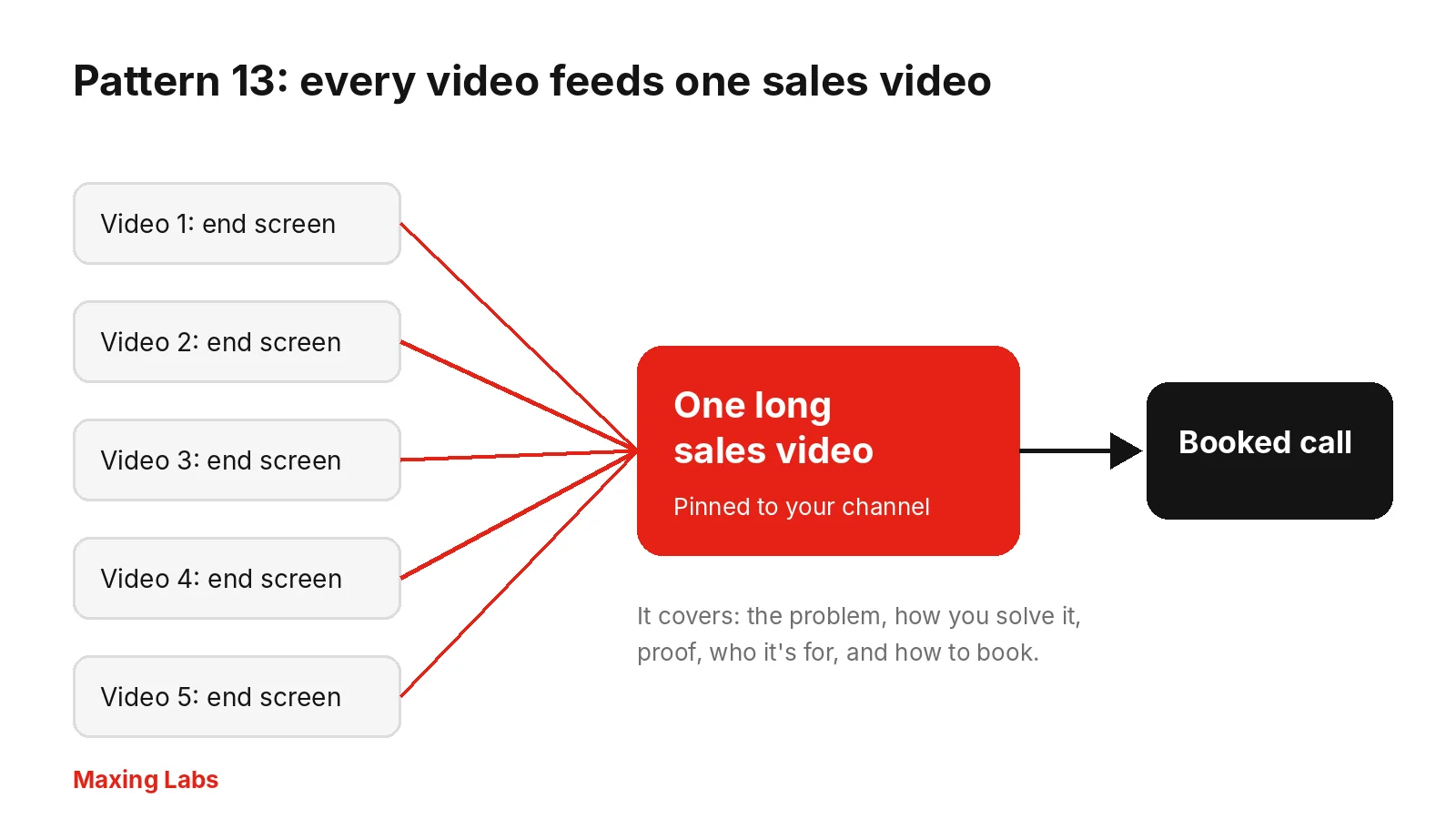
The sales video covers the problem, how you solve it, proof, who it’s for, and how to book. Pin it to the top of your channel. A few times a year, some founders add a live event with a real deadline.
14. Put one free resource and one link on every video
Changing the call to action on 50 old videos is a nightmare. So smart founders put one free resource, with one link, on every video.
What’s behind the link can change anytime: a new offer, booking page or email sequence, without touching a single video. Make it something your buyer wants now, like a checklist, template or audit, and make sure it leads to a call. Some add a regular live Q&A, which turns watchers into people who feel like they know you.
15. Match the freebie to the video
If someone watches a video about one problem, a freebie about a different one feels like a bait and switch. The brain wants the next step to continue the same conversation.
A video on lead quality gets a lead-quality checklist. A video on pricing gets a pricing template. Five or six freebies, one per big topic, is enough.
16. Make videos for what leads search before a call
Before a call, your lead searches your company name. If a stranger’s review shows up first, you’ve lost the room before you say hello.
Make videos for exactly what leads search: your company name, “reviews,” “pricing,” “is it worth it,” and you versus your biggest competitor. Answer each one honestly. Then send every new lead two videos before the call: one that handles their biggest objection and one that shows you working. They show up warm, and the call turns into a conversation.
17. Use the channel even if ads bring your leads
Some founders get most clients from ads and still run a channel, because the channel is what leads check before they buy. Someone who’s watched you for an hour clicks your ad, opens your email and shows up to the call.
Put videos in your follow-ups and send them to leads who went quiet. A side benefit: your viewers include great people to hire, because they already know how you think.
| Pattern | What to set up | Where it moves the buyer |
|---|---|---|
| 12. Pitch in every video | A 30-second pitch tied to the topic | Viewer to “this could be for me” |
| 13. One sales video | One long offer video, every end screen points to it | Viewer to booked call |
| 14. One link on every video | A single free resource you can change behind the scenes | Viewer to email list or call |
| 15. Matched freebies | 5 or 6 freebies, one per big topic | Viewer to lead on the same problem |
| 16. Pre-call videos | Name, reviews, pricing, “worth it,” vs competitor | Lead to warm call |
| 17. Channel behind your ads | Videos in follow-ups and win-back emails | Ad click or cold lead to call |
What system keeps a founder’s channel producing clients?
The system is a mix of mostly specific videos for your buyer, ideas that already worked, and title shapes you reuse. It lowers the risk of each video so you can keep going while you run the business.
18. Mix broad and specific videos
The biggest videos on these channels are broad: productivity, life, how to get rich. The ones aimed at the buyer get a fraction of the views.
As I put it in the video: “Broad gets you found. Specific gets you paid.” If you only film once a month, lean specific. Make mostly videos about your buyer’s exact problems, with a broader video now and then to reach new people.
19. Start from ideas that already worked
Every video is a bet. The best channels lower the risk by starting from ideas that already worked.
Search the topics your buyer cares about, in your market and the ones next to it. Find videos that got far more views than that channel usually gets. Make most of your videos from those, in your own words, and keep a small share for experiments. Proven ideas pay the bills. Experiments find the next one.
20. Reuse title shapes that work
This one surprised me most. The same title shapes show up on channel after channel.
These founders are original about what they know and happy to reuse packaging. When a format works, they reuse it on a new topic and improve it. Keep a list of title shapes that perform in your space, and before every video, pick one.
What this looks like for Maxing Labs clients
We use these patterns with our own clients. Two recent results, shared without names:
| Client | Starting point | What Maxing Labs did | Timeframe | Result |
|---|---|---|---|---|
| US-based B2B founder selling AI automation | No revenue from YouTube | Everything, end to end | 90 days | $50K+ revenue generated with YouTube |
| Agency owner | 0 coaching clients, wanted to start an agency | Strategy | 90 days | $40K+ in revenue |
The first client put it this way: “Before working with him I didn’t know so much goes into crafting the right content that gets sales.” The second said: “Just 2 weeks working with him I signed my first high ticket client.”
Do you need a big channel to get clients from YouTube?
No. A founder with a couple of thousand views a video can out-sell a channel with two hundred thousand if the right buyers are watching and every video points to one sales video (pattern 13). Titles that call out the buyer’s revenue and pain (patterns 6 and 7) mean fewer views, but more of those views come from people who can buy.
FAQ
How many videos does a B2B founder need before YouTube brings in clients?
There’s no fixed number. The founders I studied get calls from small channels because each video targets one buyer problem and points to a sales video. If you can only film once a month, make most of those videos about your buyer’s exact problems and pitch in every one.
Should I pitch my offer in every YouTube video?
Yes, when the viewer is the right person. A short, clear offer after you’ve given value is the natural next step for someone whose problem you just partly solved. Keep it to about 30 seconds, tie it to the topic, and say who it’s for and what happens when they book.
What should a YouTube sales video for a B2B offer include?
Cover the problem, how you solve it, proof, who it’s for, and how to book. Make it one long video, pin it to the top of your channel, and point every other video’s end screen at it. Some founders add a live event a few times a year with a real deadline.
Is it risky to give away my process for free on YouTube?
Less than it feels. Your buyer wants the result done for them, so teaching the first stage of your process in full shows them how much work it is. The viewer who tries it and sees the effort involved is often the one who books a call.
Is YouTube worth it if most of my clients come from ads?
Yes. Many founders who get most clients from ads still run a channel, because leads check it before they buy. Someone who has watched an hour of your videos is more likely to click your ad, open your email and show up to the call. Use videos in follow-ups and to re-open quiet leads.
Want these 20 patterns running on your channel?
Knowing this is the easy part. Doing it every month while you run the business is the hard part, and that’s the part we take off your plate.
Maxing Labs is a YouTube growth agency for B2B founders and coaches. If your business does $20K+ a month, book a call with Zed and you’ll get a free 90-day YouTube strategy built for your buyer, even if you don’t hire us. Our retainers run $2,000 to $5,000 a month. You can see how our YouTube growth agency for B2B founders works first.
Book your free 90-day YouTube strategy call
About the author

Zed is the founder of Maxing Labs, a YouTube growth agency for B2B founders and coaches. He helps B2B founders add $30K to $100K with YouTube, with $110K+ generated and 5M+ long-form views.